
Moving a hot tub costs between $300 and $1,200 for most homeowners, with the national average sitting at around $600. That number swings significantly depending on how far you’re moving it, how big your tub is, and what obstacles stand between the current spot and the new one.
This guide breaks down every cost factor, gives you real 2026 price data, and helps you decide whether moving your hot tub is even worth it — or if leaving it behind (or trading it in) makes more financial sense.Average Hot Tub Moving Costs at a Glance {#average-costs}
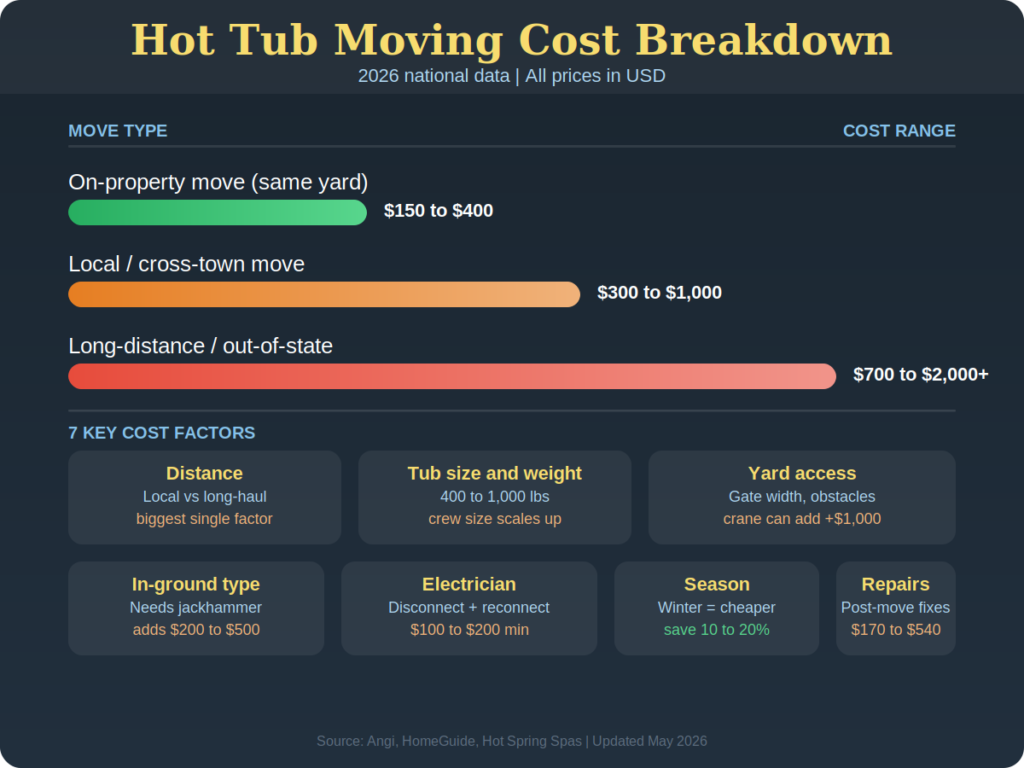
| Move type | Average cost | Typical range |
|---|---|---|
| On-property (same yard) | $200 | $150–$400 |
| Local move (cross-town) | $600 | $300–$1,000 |
| Long-distance move | $1,000+ | $700–$2,000+ |
Most local moving companies bill by the hour. A three-mover crew typically runs $75 to $150 per hour, while a four-person crew (required for larger, heavier tubs) costs $100 to $200 per hour. The average job takes three to five hours from start to finish.
If the company prices by weight rather than time, expect additional charges once the tub exceeds a certain threshold — usually around 500 pounds.
7 Factors That Affect Your Final Price {#cost-factors}
1. Distance
Moving your hot tub to a new spot in the same yard is the cheapest scenario — usually a flat rate in the $150–$400 range. Moving it across town adds truck rental, fuel, and loading time. Moving it to another state requires a long-haul freight company, and costs can exceed $2,000 depending on mileage.
2. Tub size and weight
Empty hot tubs weigh anywhere from 400 to 1,000 pounds. A compact four-person tub is manageable with three movers; an eight-person luxury model may need four to six. The larger the crew, the higher the hourly bill.
3. Yard and access conditions
Can the moving truck park within 20 feet of the tub? If not, every extra foot of carry costs money. Narrow gates, soft landscaping, low-hanging structures, or any situation requiring the tub to pass through interior spaces all push the price up. A gate just an inch too narrow may mean the movers have to remove it — or partially disassemble the tub.
4. Freestanding vs. in-ground
Portable, above-ground hot tubs are the easiest and cheapest to move. In-ground or concrete-set tubs require a contractor to cut or jackhammer the base before the tub can be lifted — that labor alone can add several hundred dollars to the total.
5. Electrician fees
Moving the electrical connection to a new location — or disconnecting it at the old one and reconnecting it at the new one — costs a minimum of $100 to $200 for an electrician. If new wiring needs to be run, budget higher.
6. Timing and season
Movers are busiest in summer and on weekends. Scheduling a mid-week or winter move can save 10–20% off the standard rate. Some companies offer flexible-schedule discounts if you can accommodate their availability.
7. Post-move repairs
Even a careful, professional move can shake loose jets, fittings, or seals. Budget $170 to $540 for any repairs that may be needed after transit. Getting the movers to document the tub’s condition before and after with photos protects you if damage is disputed.
Should You Bring or Leave Your Hot Tub When Moving? {#bring-or-leave}
This is the question that ends up on r/hottub constantly, and the answer depends on a few practical factors.
Bring it if:
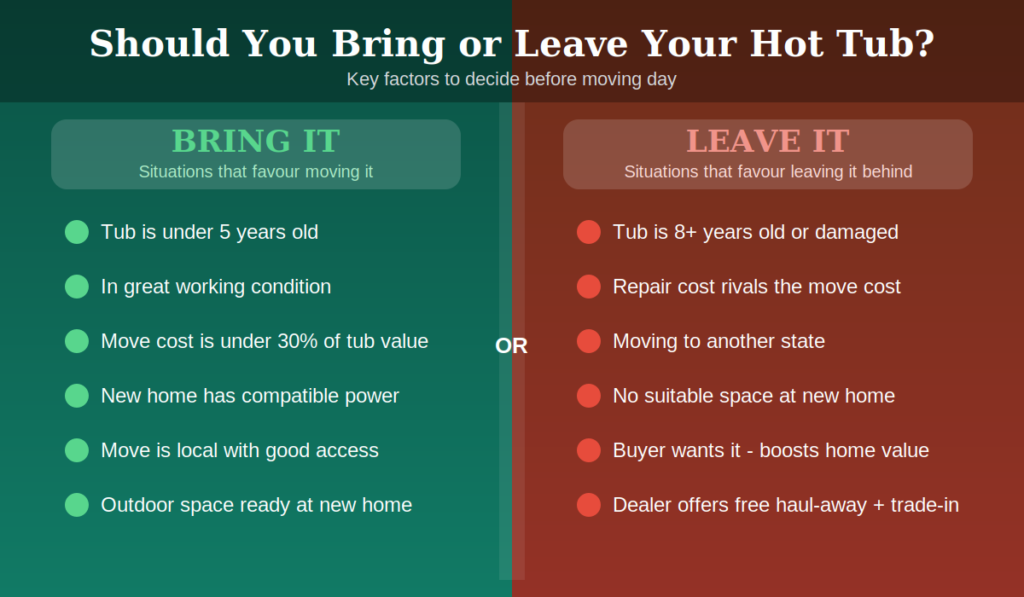
- The tub is less than five years old and in good working condition
- Your new home has a compatible electrical setup and outdoor space
- The move is local and access at both properties is easy
- Moving cost is less than 30% of the tub’s current market value
Leave it (or sell it) if:
- The tub is over eight to ten years old, or has existing issues
- Moving cost rivals or exceeds what a replacement would cost
- The new home lacks the space, power supply, or permitting for a spa
- You’re moving long-distance and freight costs are prohibitive
One option worth exploring: nearly all hot tub dealers will haul away your current tub for free when you purchase a new one, and many offer a trade-in credit. If your tub is aging, that deal often beats paying to move it.
A word on home sales: a well-maintained hot tub can add perceived value to a listing. If you’re selling, check with your agent before committing to taking the tub with you — the buyer may want it included.
How to Find the Best Hot Tub Movers Near You {#find-movers}
Not every moving company has experience with spa relocation. A general mover without specialized equipment can cause expensive damage. Here’s what to look for:
Before hiring, verify:
- They carry liability insurance that explicitly covers hot tubs
- They have at least five years of experience with spa moves
- They use a proper spa dolly and moving blankets (not just straps)
- They provide an itemized written estimate, not a verbal ballpark
- They do not require full payment upfront — pay a deposit, balance on completion
Questions to ask:
- Do you have experience with my specific tub size and type?
- Is your truck large enough, or will you need a specialty vehicle?
- What happens if the tub is damaged during the move?
- Does your quote include disconnection, reconnection, and site prep?
Collect at least three quotes. The lowest bid is not always the best — it may exclude reconnection fees or insurance that competitors include. Read Google reviews and look specifically for mentions of hot tub moves, not just general moving jobs.
How to Save Money on Your Hot Tub Move {#save-money}
A few straightforward steps can meaningfully reduce what you pay:
Drain it yourself. This is the single biggest cost lever. If movers arrive and the tub is still full, they charge to drain it — and water makes the tub far heavier, requiring a larger crew. Drain it completely at least 24 hours before pickup, and use a pump to get residual water out of the plumbing lines.
Move off-peak. Mid-week moves in late fall or winter routinely come in 10–20% cheaper than summer weekend slots.
Bundle your move. If you’re hiring movers for the whole household anyway, ask whether bundling the hot tub move reduces the per-item rate. Many companies discount when there’s more work to quote.
Remove loose parts yourself. Detach and pack any removable accessories, jets, or cover lifters before the movers arrive. Less work on their clock means a lower final invoice.
Get quotes from three or more companies. Prices for the same move can vary by hundreds of dollars between providers. Use that spread as negotiating leverage.
FAQ {#faq}
How much should I pay for a hot tub in 2026?
A new hot tub costs between $2,500 and $35,000 depending on size and features. Entry-level portable models start around $2,500–$5,000. Mid-range value tubs run $5,000–$8,000. Premium and luxury spas start at $8,000 and can exceed $20,000. The national average purchase price is around $6,000.
How expensive is it to maintain a hot tub?
Ongoing maintenance costs average $50 to $100 per month, which covers electricity ($20–$30/month on average), chemicals ($20–$50/month), and occasional filter replacements. Annual professional servicing adds another $150 to $300. Budget roughly $800 to $1,500 per year in total running costs.
How much does it cost to put in a jetted tub?
Installing an in-ground jetted tub costs between $6,000 and $15,000, depending on excavation requirements, plumbing, and electrical work. A freestanding plug-and-play jetted tub can be placed for as little as $2,500–$5,000 plus an electrician’s connection fee of $100 to $200.
How many people does it take to move a hot tub?
A small four-person hot tub typically requires at least three strong adults. A six-person or larger tub usually requires four to six people. Professional movers bring specialized dollies and equipment that reduce the crew size needed — one key reason to hire pros over coordinating friends.
Can I move a hot tub myself?
Technically yes, but it’s genuinely risky. An empty hot tub still weighs 400 to 1,000 pounds and requires a spa dolly, tie-down straps, moving blankets, wooden support boards, and a truck rated for the weight. DIY costs (truck rental, equipment rental, supplies) often approach what professionals charge — without the insurance coverage. For anything beyond a short roll across a flat surface, professional movers are worth it.
Ready to Move Your Hot Tub?
The bottom line: most hot tub moves cost $300 to $1,000 for a local relocation, with the average landing around $600. Long-distance and in-ground moves push that number significantly higher.
Get at least three quotes from insured, experienced movers, drain the tub yourself before they arrive, and schedule off-peak if you can. Those three steps alone can save you $200 or more.
Looking for movers in your city? Check our city-specific guides for current pricing in Portland, Los Angeles, Houston, Phoenix, and more — or use our Hot Tub Moving Cost Calculator to get an instant estimate based on your specific situation.
Last updated: May 2026. Cost data sourced from Angi, HomeGuide, and Hot Spring Spas industry reports.